
Category: Events
BioCannDo: 5. Networking Webinar on the Communication of Bio-Based Products
Join us for a webinar on 10 May 2019 at 11:00 AM CEST.
Are you involved in promoting innovative bio-based products, or engaging stakeholders in dialogues on the bioeconomy, and interested in recent initiatives? Then you may want to engage with other stakeholders that share your interest and join our webinar.
BioCannDo is about explaining the idea of the bioeconomy and of bio-based end products in a clear and understandable language, in a scientifically correct manner, and connecting it to everyday life. Collaboration partners can share and learn about innovative approaches and good practices in approaches and formats for bioeconomy awareness raising and education.
What can you expect from the webinar:
We will present a brief overview of BioCannDo project results. Then you will hear about the outcome of comparing results of a literature survey, conducted in the RoadToBio project, and three consumer surveys, conducted in a live setting in the BioCannDo project, on public perception of bio-based products. In the third session you will learn about BLOOM project results to engage different stakeholder groups in Austria and Germany in co-creation workshop to learn about their hopes and fears regarding the implementation of the bioeconomy.
Webinar agenda:
1. Snapshot of BioCannDo results – Erik Lohse, FNR (DE)
2. Communication on bio-based products: BioCannDo consumer surveys & RoadToBio literature analysis – John Vos and/or Swinda Pfau, BTG Biomass Technology Group (NL)
3. BLOOM: Bioeconomy co-creation workshop experiences in Austria & Germany – Clemens Gattringer, Ecosocial Forum (AT)
Interested? Check our website www.allthings.bio to learn more about BioCannDo and register now to join our 1-hour webinar on Friday 10 May (11:00-12:00). You are welcome to share this invitation with other members of the bioeconomy community.
After registering, you will receive a confirmation e-mail containing information about joining the Webinar.
Promising opportunities for circular agro-food industries
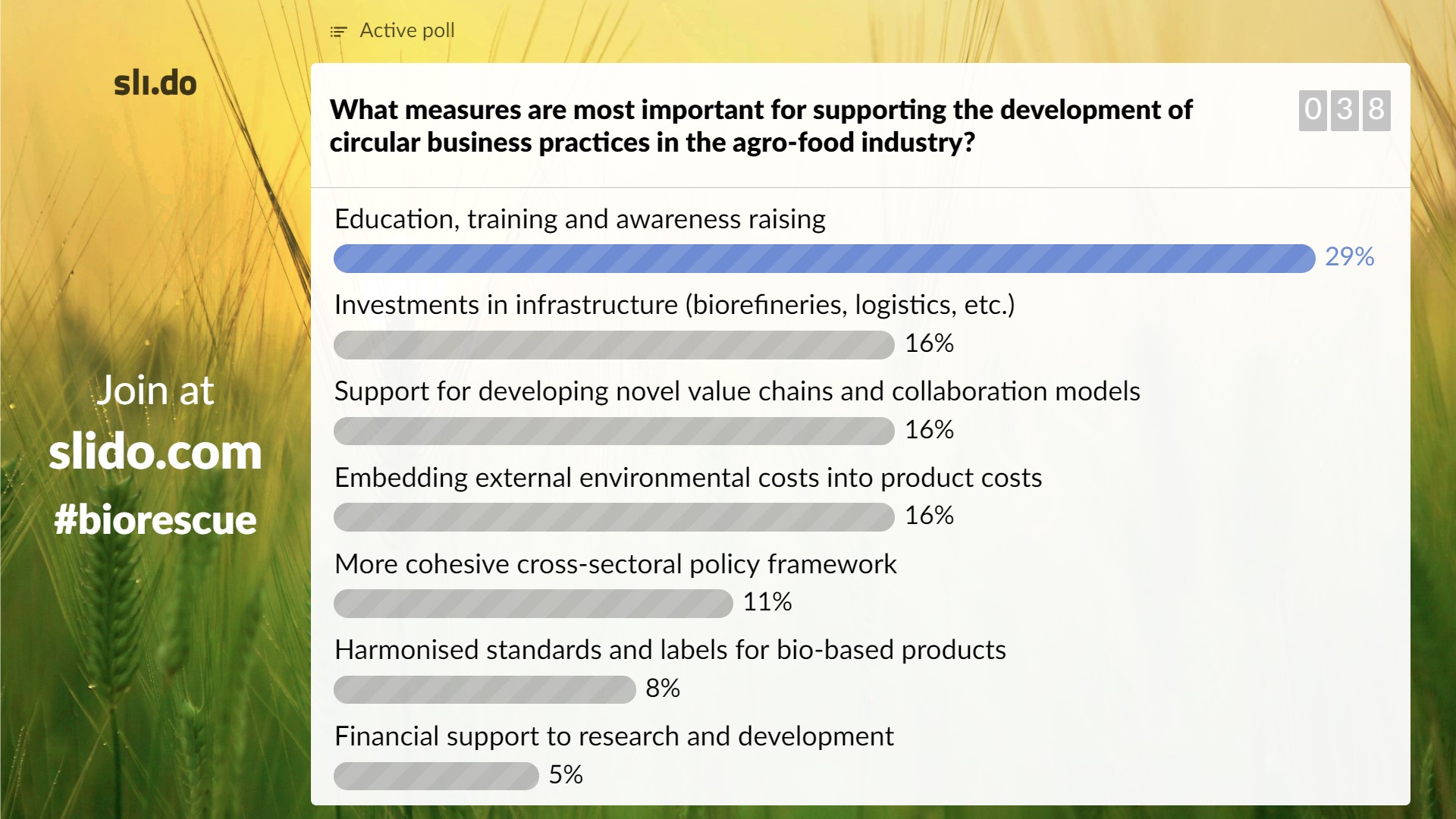
Education, training and awareness raising were identified as key factors to unlock the potential of 62 million tonnes of agricultural residues available annually in Europe during a policy conference organised by eco-innovation expert group Greenovate! Europe, where innovative examples of circular economy in the agro-food sector were presented.
Rural areas cover more than 50% of Europe’s surface, and provide food and natural resources to millions of European citizens each day. Most of these resources are currently supplied to cities, but how can we move towards a more circular economy, and return to rural areas the benefits they bring to society? Whilst a traditional industry, the agro-food sector can benefit from opportunities arising from the development of circular business practices. In that sense, new business models are emerging across the world to address climate challenges and contribute to the revitalisation of rural areas.
These topics were discussed at the conference “Towards a circular agro-food industry” on 4 April 2019 in Brussels, which identified solutions to deploy circular agro-food systems across Europe. The conference, which was also the final event of the EU-funded BIOrescue project, brought together over 80 participants, including policy makers and industry players, as well as key representatives from research institutions.
Good practices from the agro-food sector
As an inspiration for participants, the event presented best practices from the agro-food sector in the adoption of circular business models, including the case of Monaghan Mushrooms, technical coordinator of the BIOrescue project, as well as replicable business models collected across Europe by the RUBIZMO project. Several innovative examples from the agro-food sector were featured, covering:
- A novel biorefinery concept to transform used mushroom compost and other underutilised agricultural residues into bio-based products, developed within the BIOrescue project;
- A Spanish cooperative Oleicola el Tejar, using olive pomace to produce local renewable energy;
- A biomass boiler using miscanthus and flax waste installed by Stephan Henry, a rural entrepreneur based in Belgium.
“European research projects like BIOrescue can provide new solutions to create added value from what is currently considered as waste in the agro-food industry”, Inés del Campo, Senior R&D Engineer at the National Renewable Energy Centre of Spain (CENER), and coordinator of the BIOrescue project, said at the event. “Not only will the concept create new revenue streams for farmers, but thanks to its circular approach, it also provides the agro-food sector with sustainable products that can be produced and used locally, as a replacement to fossil-based alternatives, such as microscopic and biodegradable polymer capsules for targeted drug delivery, and biopesticides.”
Recommendations for policy
Highlighting the benefits of circular economy for rural areas, participants also discussed the barriers faced by agro-food businesses in the adoption of circular business practices. The BIOrescue project presented and debated a set of policy recommendations towards the development of a circular economy in European agriculture.
Investment in research initiatives, and especially public-private partnerships such as BIOrescue, is still needed to help connect the agro-food sector with the potential offered by the bio-based industry. In agro-food value chains, collaboration and training, as well as investments in infrastructures and logistics, will also offer strong incentives to the sector to close the loop towards more circular business practices. But for the circular economy to become a reality in the agro-food industry, a clear and cohesive policy framework with stronger integration of policy objectives across sectors, promoting a cascading use of biomass sources, will be key to create a level playing field for bio-based products, avoiding competition with bioenergy while considering their contribution to climate change mitigation.
You can find here the agenda, handouts and pictures from the event (Photography Simon Pugh).
Presentations can be downloaded below, and the policy recommendations from the BIOrescue project are also accessible online.
Towards a circular agro-food industry
- Delivering the Bioeconomy Strategy and Action Plan for agro-food businesses, Wim Haentjens, Policy Officer, European Commission, DG Research and Innovation
- Challenges and opportunities for circular business practices in rural areas, Laura Jalasjoki, Policy Analyst, European Network for Rural Development
- Circular economy as an industry practice: the case of Monaghan Mushrooms, Darragh Gaffney, Research and Development Manager, Monaghan Biosciences
- Supportive business environments for rural innovation: inspiration from the RUBIZMO initiative, Muluken Adamseged, Researcher, Leibniz Institute for Agricultural Engineering and Bioeconomy
- A circular biorefinery concept for agro-food residues: the BIOrescue project, Inés del Campo, Senior R&D Engineer, National Renewable Energy Centre of Spain (CENER)
- Recommendations for a circular economy in European agriculture, Bénédicte Julliard, Project Manager, Greenovate! Europe
- The EU legislative framework to support circular agro-food systems, Natalia Brzezina, Policy Officer, European Commission, DG Agriculture and Rural Development
- Developing new bio-based value chains through public-private partnerships, Pilar Llorente, Project Officer, Bio-Based Industries Joint Undertaking
For more information, you can visit the BIOrescue website at www.biorescue.eu, read our latest publication, watch our project video, and access further project communication material in our Media Kit.
Press and media enquiries can be directed to b.julliard@greenovate-europe.eu +32 (0)2 00 10 07.
Open survey for the Blue Bioeconomy Forum roadmap
The Blue Bioeconomy focusses on novel and innovative uses of renewable biological resources in aquatic and marine environments to develop food, feed and non-food products, including among others, chemicals, fertilisers, building materials, pharmaceuticals, and cosmetics.
The Blue Bioeconomy Forum brings together different stakeholders in the blue bioeconomy to further the development of this promising sector. We are engaging with the community to better understand the challenges that all the different actors face in promoting growth and business opportunities, as well as research challenges that hamper the roll-out of new innovations. We organised an event on 7 December 2018 to gather input and held workshops on 11-12 March to further gather detailed information for this roadmap.
Now we would like to engage with the wider community (of which you are part) to help us shape the content of the roadmap, to be presented on 25 June in Brussels.
We would highly appreciate your input! Please help us further explain and understand the potential of the blue bioeconomy. You can do so by filling in this survey and/or forwarding it to a colleague. The survey is intended for members of the business and research community who are active in the blue bioeconomy.
To take the survey click HERE
Yours sincerely,
the Blue Bioeconomy Forum Secretariat.
Biomass analysis: the key to success for your biorefinery process
Bioeconomy is a new buzzword, but how can you get involved? Perhaps you have valuable biomass resources, but don’t know what they are made of and what they could be used for? Celignis Analytical is the partner you need for your project! Born from the successful research project (DIBANET) coordinated by the Carbolea Biomass Research Group at the University of Limerick, Celignis has subsequently been developing innovative methodologies to improve biomass analysis processes.
Celignis founder Dr. Daniel Hayes discovered that although feedstock composition was a critical factor for the success of biomass transformation processes, precise data was missing for a wide range of feedstocks. To address this issue, and avoid future problems in conversion processes, companies used to subcontract laboratories to chemically analyse biomass samples. This process is time consuming and expensive: taking approximately two weeks per sample, and costing hundreds of euros. Looking for solutions to improve this process, Celignis created a novel methodology for biomass analysis, modelling samples’ composition according to the results of a Near Infrared spectroscopy analysis. Their method uses infrared light to determine the presence and quantity of important constituents in biomass materials. Following the analysis of hundreds of samples of different feedstocks across the world, Celignis developed unique algorithms to predict with high accuracy and precision the composition of biomass samples. In that way, up to 13 different parameters, including type and amount of sugars, lignin and ash, can be analysed for various types of biomass. And this in only one day, for less than a hundred euros per sample.
This process has been instrumental in the successful development and implementation of the BIOrescue biorefinery process. First of all, to analyse and predict the composition of used mushroom compost samples. Using complementary chemical analysis when necessary, Celignis could determine the type and amounts of sugar, lignin and ash present in the compost. Secondly, the models were also used to select the most suitable combination of used mushroom compost and other agricultural residues that will safeguard the success of the biorefinery process. After running several tests with feedstocks from various European regions, Celignis experts found out that wheat straw, oat straw and barley straw were the most efficient to be combined with used mushroom compost to achieve a balanced composition of sugar and lignin for a productive biorefinery process. Based on this they determined precise balances of feedstocks to optimise process efficiency.
“In the transition towards a circular bioeconomy, we believe that accurate biomass analysis services are a key factor to unlock successful and profitable exploitation of sustainable biomass sources”, says Dr Hayes, “In that sense, we want to help companies reaching their full potential by providing them with precise data which will enable them to control each step of the biomass transformation process”. After mushroom compost, Celignis is looking forward to exploring new types of underutilised biomass and creating custom-made algorithms for rapid biomass analysis that will foster the development of innovative bio-based processes, and in the long run, the expansion of the bio-based industry across Europe.
For more information, you can visit the BIOrescue website at www.biorescue.eu, watch our project video, and access further project communication material in our Media Kit.
Press and media enquiries can be directed to b.julliard@greenovate-europe.eu +32 (0)2 00 10 07.
European Bioeconomy Scene 2019
A unique conference on the bioeconomy, to be held this year in the vibrant seaside city of Helsinki, will present new issues and offer insights into bio-based value chains and the related socio-economic aspects. The objective of European Bioeconomy Scene 2019, which will take place on 8–10 July, is to achieve an inclusive and sustainable bioeconomy for Europe.
The Ministry of Agriculture and Forestry of Finland and the European Commission are jointly organising the conference as one of the main events to be held in Helsinki during Finland’s Presidency of the Council of the European Union. The conference is one of the absolute highlights of the bioeconomy sector in Europe, and registration will be open until 25 April 2019 for a limited number of participants.
The bioeconomy is a sustainable solution aiming to combat urgent global problems, such as climate change, increasing competition for natural resources and regional development. In order to implement the transition to the bioeconomy at the European level, we need better consensus, commitment and decisions.
The conference aims to raise public awareness and promote dialogue on our progress towards bioeconomies. This will be accomplished by bringing together academics, researchers, stakeholders, policymakers and business representatives and the civil society across the bioeconomy sector to exchange knowledge, coordinate activities and discuss new actions. A wide range of participants is expected from around the European Union.
The objective of the conference is to exchange ideas on how to proceed in implementing the updated Bioeconomy Strategy “A sustainable Bioeconomy for Europe: strengthening the connection between economy, society and the environment” from 2018 and the Circular Economy Package.
The conference programme, registration and descriptions of the excursions can be found at www.bioeconomy.fi/EUBioScene19

8 July 2019 – BIOVOICES and BIOCANNDO in collaboration with Biobridges and LIFT, during the European Bioeconomy Scene 2019 to be held in Helsinki, will organise an European MML “The role of communication and education to promote changes in purchase habits and increase the adoption of bio-based products” The workshop will bring together EU funded project , European Platforms and Networks, Member states networks, together with quadruple helix stakeholders dealing with communication and awareness raising, to support the European Bioeconomy Strategy through communication activities.
The workshop will promote the discussion and sharing of lessons learned and best communication practices, formats and channels; successful activities, multipliers to be involved; messages and arguments to be used (in terms of style, scope, terminology), etc.
The workshop will facilitate the creation of synergies to maximise the opportunities and impact of bioeconomy communication at national and European Level.
For more information about the MML and for the registration please visit the website: www.biovoices.eu/helsinki
BIOVOICES – Mobilisation and Mutual Learning Workshop on Waste Valorisation, 9th April, UK
BIOVOICES – Mobilisation and Mutual Learning Workshop on Waste Valorisation
Date: 9th April
Time: 9:30am–4:30pm
Venue: Biorenewables Development Centre
Address: 1 Hassacarr Close, Chessingham Park, Dunnington, York, YO19 5SN
BioVale, Biorenewables Development Centre (BDC) and Minerva Communications are hosting a workshop focused on the advancement of bio-based products and processes in the UK market, contributing to a national drive to collect and collate view on challenges and opportunities facing the bio-based sector.
Minerva, as the UK partner for the EU funded H2020 project BIOVOICES, is working towards identifying and overcoming key challenges currently hindering the uptake of bio-based products across Europe. Through a series of Mobilisation and Mutual Learning events, Minerva is promoting dialogue to identify and address the key challenges relevant to the UK market.
The aim of this event is to identify these challenges and work towards overcoming them to advance the bio-based economy within the UK.
This event, one of four regional UK events, will focus on waste valorisation, which is driving a wide range of bio-based areas and the production of bio-based products, with the aim to identify key challenges and work through a combined effort to agree ways to progress the UK bio-based industry through discussions with key figures from each of the identified stakeholder; Civil Society, Business and Innovation, Research and Education and Public Administration.
If you are interested in attending, please email emma.needham@biovale.org with your details and we will get in touch.
Agrimax survey: we want to know your thoughts on bio-based products for food and packaging
Food ingredients and packaging additives can be extracted from by-products and wastes of the agrifood production chain.
The Agrimax project would like to find out your assessment of the applicability of these compounds in today’s food businesses.
Agrimax – an EU-funded project that is developing and demonstrating the production of multiple, high-value products from crop and food-processing waste by building two, flexible, multi-feedstock pilot biorefineries in Europe. The project aims to tackle Europe’s food waste problem as around 90 million tonnes of food and 700 million tonnes of the crop are wasted every year. The project will maximise the EU’s sustainability while providing new biobased compounds for the chemicals, food-packaging and agricultural sectors.
It will take around 10 minutes to fill in the survey. All answers will be handled anonymously; it is not possible to track back any answer to any participant of the survey.
Take the survey – https://goo.gl/forms/tn1Q8vSdJD5JYhg63
(The survey is open until the 30th June 2019.)
BBI JU INFO DAY 2019
The BBI JU Info Day 2019 will take place on 12 April 2019 in Brussels.
The aim of the event is to bring together potential participants interested in the BBI JU 2019 Call for proposals.
Registration for the event is free but obligatory and needs to be completed using the electronic registration tool. Places will be offered on a ‘first-come, first-served’ basis so we would advise to register as soon as possible.
The morning sessions will provide information about the BBI JU initiative and all aspects of the Call process. Details of the 2019 Call topics as well as more information on the event are available on the BBI JU website.
The afternoon will provide an opportunity for participants to hold face-to-face meetings that can be scheduled as of 8th of March using the professional/corporate profile in the BBI JU Partnering Platform.
Throughout the day, participants will have the opportunity to speak to representatives from BBI JU’s founding partners and Member States as well as exchange views with entities in synergy with BBI JU. The BBI JU’s Programme Office staff will also be available to answer questions about the Call process and procedure.
We look forward to welcoming you to our 2019 Info Day in Brussels!
Read the news on BBI JU website
The ENRD Thematic Group on ‘Mainstreming the Bioeconomy’ is organising a Twitter chat on rural bioeconomy
How to inform farmes, rural SMEs and other stakeholders about the benefits of #bioeconomy for rural areas?
The ENRD Thematic Group on ‘Mainstreming the Bioeconomy‘ is organising a new Twitter chat about awareness raising. Join us on 19 March at 11.00! #bioeconomy
Bioeconomy can have many positive outcomes from rural stakeholders, including climate benefits, job creation, business developments… but how to communicate clearly to stakeholders about such opportunities? How to disseminate technological and social innovations related to bioeconomy? Join us to share your experience and learn from others!
Follow @ENRD_CP on Twitter and use #bioeconomy on 19 March, 11.00-12.00 CET time.