
Category: Biomass availability, quality, supply and sustainability

 BIO4ECO project

 BIO4ECO project

Project concluded

BIO4ECO aims to improve regional and national policy processes and policy implementation and delivery addressing the transition to a low carbon economy, in relation with renewable energy use, energy efficiency of building, and forest and agricultural biomass.
The main expected outcomes are:

  • increase the share of renewable energy in the overall energy mix (17 M€ of ERDF funding benefited by the project)
  • take into account bioenergy and bioeconomy in all planning and decision-making
  • lay the groundwork for future integrated strategies and programmes for regional bioeconomy and carbon neutrality.

BIO4ECO will organise interregional and local learning process by thematic workshops, study visits and local stakeholder groups meetings, to achieve a greater integration among the lessons learned. These are going to be the cornerstone of the learning process.
Topics that will be worked in these events are the following:

  • Role of forests within regional and national low carbon and bioeconomy strategies and programmes
  • First-hand experience on integral solutions for bioenergy policies and strategies
  • The Energy-Foof-Water land use nexus: possible equilibrium for the low-carbon transition
  • How to increase social acceptance of bioenergy policies?
  • Priorization of bioenergy production at different geographical scales

Contacts: Adriano Raddi: adriano.raddi@ctfc.cat

Website

 BalticBiomass4Value project

 BalticBiomass4Value project

Project concluded

The Baltic Sea Region (BSR) holds a great potential for circular bioeconomy development. Therefore, the BalticBiomass4Value project aims to enhance capacity of public and private actors within the BSR to produce bioenergy in more environmentally sustainable and economically viable way by utilizing new biomass sources (chiefly, biological waste) for energy production, as well as possibilities to use bioenergy side streams for higher value bio-products. Biomass from different sources (agriculture, food and feed industry, forestry, wood industry, municipal waste and sewage sludge, fishery, algae), its logistics, various biomass conversion technologies and value chains will be mapped to identify best practices of bioenergy generation and the potential of more efficient and sustainable deployment of biomass in the BSR.

Seventeen partners from LithuaniaLatviaEstoniaGermanyPolandSwedenNorway and the Russian Federation will bring together the producers of biomass and bio-based products, as well as relevant public authorities and policy stakeholders for the implementation of the project.

Contacts: Virginija Kargytė: virginija.kargyte@vdu.lt
Lena Huck: l.huck@fnr.de

Website

 AgriChemWhey project

 AgriChemWhey project

Project concluded

Objective

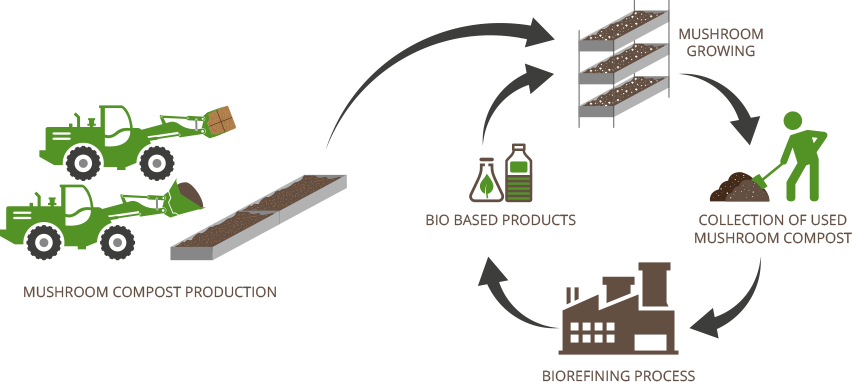
Whey Permeate (WP) and De-lactosed Whey Permeate (DLP) are major side-streams of dairy processing and represent a key challenge for the dairy industry due to a lack of reliability in current disposal routes and represent a sustainability bottleneck for the expansion of milk production in Europe in the “post-milk-quota era”. AgriChemWhey will build a first-of-a-kind, industrial-scale biorefinery with integrated symbiotic industrial and agricultural value chains that will valorise over 25,000 tonnes (100% dry matter) per annum of excess WP and DLP to several added value products for growing global markets including lactic acid, polylactic acid, minerals for human nutrition and bio-based fertilisers. This will be achieved through a coordinated investment process and development path to realise the Flagship plant, representing the first major industrial venture to convert residues from food processing, as second generation feedstocks, to value added bio-based products. The Flagship will prove the techno-economic viability of the innovative WP/DLP-to-lactic acid biorefinery technology and will establish a new value chain for industrial symbiosis with other local actors for the production of high value sustainable food and feed (including high quality mushrooms) products from other side streams, as an enhanced circular bioeconomy approach to agriculture and agri-food waste. This offers society and industry the opportunity for greater resource efficiency – less food waste, more products from the same starting material (milk), and integration of food and non-food material production. AgriChemWhey will also develop a blueprint of an economic sustainability concept and replication plans for other regions across Europe, thus maximising both short and long term impacts, contributing towards the development of the European bioeconomy to promote rural growth, competitiveness and job creation, and aligning with European sustainability targets.

Contacts:

Rodrigo Arandi-Klee EU Project manager rodrigo.arandi@greenwin.be

Marian Murphy, Project Management marianmurphy4286@gmail.com

Fergal Lawless,  Technical Management flawless@glanbia.ie

Website